Italy Work Permit Visa is an important option for non-European Union (non-EU) citizens who want to live and work legally in Italy. The country offers employment opportunities in agriculture, hospitality, construction, manufacturing, logistics, healthcare, and other sectors. However, foreign nationals generally need a genuine job offer and the appropriate work authorization before applying for an employment visa.
For applicants from Bangladesh and other countries outside the EU, understanding the Italian work permit system is essential. This guide explains the types of Italy work visas, eligibility requirements, necessary documents, application procedures, expected salaries, processing times, and important precautions for 2026.
What Is an Italy Work Permit Visa?
An Italy work permit visa allows eligible foreign nationals to enter Italy for employment under the applicable immigration rules. In many cases, an Italian employer must first obtain a work authorization known as Nulla Osta al Lavoro from the relevant immigration authority.
After the authorization is issued and the required checks are completed, the applicant can apply for the appropriate visa through the designated Italian visa application process.
Most employment applications from outside the EU are governed by Italy’s immigration quota system, known as the Decreto Flussi. Certain categories, including some highly skilled workers and other special employment cases, may follow separate procedures.
The work authorization, entry visa, and residence permit are different documents. Applicants must complete the relevant stages to work and reside legally in Italy.
Types of Italy Work Visas
Italy offers several employment-related visa categories. The appropriate option depends on the job, employment contract, qualifications, and applicable immigration rules.
1. Italy Seasonal Work Visa
The seasonal work visa is suitable for eligible foreign workers employed in seasonal activities. Common opportunities include:
- Fruit and vegetable harvesting
- Apple and grape picking
- Agricultural farm work
- Hotel and resort services
- Tourism-related seasonal employment
Seasonal employment is generally temporary. The permitted period depends on the authorization and visa conditions.
2. Italy Non-Seasonal Work Visa
A non-seasonal work visa is intended for eligible employment that is not limited to a seasonal period. Depending on the available quotas and legal requirements, opportunities may include:
- Construction and building work
- Manufacturing and factory jobs
- Transportation and logistics
- Restaurant and hospitality services
- Technical and skilled occupations
- Certain care and service positions
Applicants must have a qualifying job offer and meet the requirements for the relevant immigration category.
3. Italy Highly Skilled Worker Visa
Qualified professionals may be eligible for special immigration routes, including the EU Blue Card, depending on their qualifications, employment offer, salary, and other legal conditions.
These routes can be relevant to engineers, IT professionals, technical specialists, researchers, and other eligible professionals. Some highly skilled employment categories operate outside the standard Decreto Flussi quotas.
4. Italy Self-Employment Visa
Foreign nationals who intend to establish a qualifying business or work independently may be eligible for a self-employment visa.
This category has specific requirements involving authorization, professional activity, financial resources, and any applicable quotas. It is different from a standard employee work permit.
Italy Work Permit Visa Requirements
Applicants must meet the conditions for their particular visa category. Requirements may differ according to the type of employment and the applicant’s circumstances.
Common requirements include:
- A valid passport.
- A genuine job offer from an eligible employer in Italy.
- A valid Nulla Osta when required.
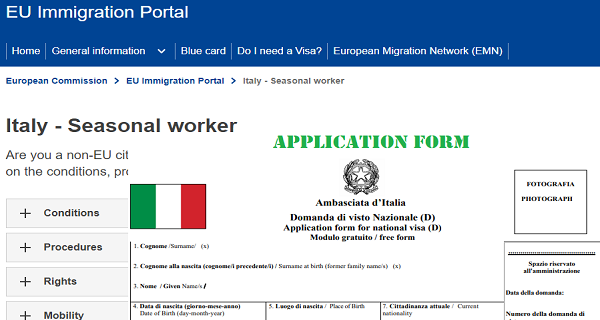
- A completed national visa application form.
- Recent passport-size photographs.
- An employment contract or relevant job documentation.
- Evidence of professional qualifications or experience, when applicable.
- Additional documents requested by the Italian Embassy or authorized visa application centre.
Applicants should also ensure that their personal information, employment details, and supporting documents are consistent.
Meeting the basic requirements does not guarantee visa approval. The competent authorities assess each application under the applicable immigration rules.
Documents Required for an Italy Work Visa
Preparing the correct documents can help applicants avoid unnecessary delays.
The following is a general checklist:
- Original passport and required copies.
- Completed Italian long-stay visa application form.
- Recent passport-size photographs.
- Work authorization or Nulla Osta, where applicable.
- Job offer and employment contract details.
- Educational certificates or professional qualifications, if required.
- Evidence of relevant work experience, where applicable.
- Additional documents requested for the specific visa category.
- Visa appointment confirmation and applicable application fee.
The exact document list may vary. Applicants from Bangladesh should check the current instructions published by the Embassy of Italy in Dhaka and the authorized visa application centre before submitting an application.
Official visa information is available through the Embassy of Italy in Dhaka and the Italian Visa Application Portal.
How to Apply for an Italy Work Permit Visa
The application process usually involves several stages.
Step 1: Find a Genuine Job in Italy
The first step is to find an Italian employer willing and legally able to recruit a foreign worker.
Applicants can explore company career pages, reputable recruitment agencies, and legitimate employment platforms. Before accepting an offer, verify the employer’s identity, workplace, job duties, salary, and contract conditions.
A job advertisement alone does not mean that a work permit has been approved.
Step 2: Employer Applies for Work Authorization
For many employment categories, the employer submits an application for the Nulla Osta through the relevant Italian immigration system.
The application may be subject to available quotas, employer eligibility, financial capacity, and other legal checks.
The applicant generally cannot replace this employer-led authorization process with a personal application for a standard employed-worker permit from abroad.
Step 3: Complete the Required Verification
Italian authorities review the employer’s application and the supporting information. Additional verification may be necessary before authorization can be used for a visa application.
The employer and applicant should follow official instructions and respond to requests for further information when required.
Step 4: Apply for the Italy Work Visa
Once the necessary authorization is available, the applicant follows the applicable visa application procedure.
For applicants in Bangladesh, the Embassy of Italy in Dhaka provides country-specific instructions, including information about the VFS Global process and the dedicated web form for eligible Decreto Flussi applicants.
Applicants should check the current procedure for their particular Nulla Osta rather than assuming that every authorization follows the same process.
Step 5: Attend the Appointment and Submit Documents
Applicants may need to provide original documents, photographs, biometric information, and other supporting materials according to the instructions for their visa category.
The authorities may request additional documents or conduct further checks. Submitting an application does not automatically guarantee a visa.
Step 6: Travel to Italy and Complete Residence Formalities
After the visa is approved, the applicant can travel in accordance with its validity and conditions.
Foreign nationals entering Italy for employment generally need to complete the applicable residence formalities after arrival, including applying for the required residence permit within the prescribed period.
Workers should confirm the relevant deadlines and requirements before travelling.
Italy Work Permit Visa Salary
Salary depends on the occupation, employer, region, working hours, experience, and applicable collective employment agreement. There is no single salary that applies to every Italy work permit holder.
The following figures are illustrative monthly gross salary ranges, not guaranteed offers or official minimum salaries for specific occupations.
| Job category | Illustrative monthly gross salary |
|---|---|
| Agricultural worker | €1,000–€1,600 |
| Hotel and restaurant worker | €1,200–€1,800 |
| Factory worker | €1,300–€2,000 |
| Construction worker | €1,400–€2,300 |
| Warehouse and logistics worker | €1,200–€1,900 |
| Experienced technical worker | €1,800–€3,000+ |
| Qualified IT professional | €2,500–€4,500+ |
Actual earnings can fall outside these ranges. Some positions include overtime, shift allowances, accommodation, meals, or other benefits, while others do not.
Important: Gross salary is the amount before applicable taxes and social contributions. Take-home pay will usually be lower. Always review the written contract to understand the salary, working hours, deductions, and benefits.
Italy Work Permit Visa Processing Time
There is no universal processing time for an Italy work permit visa. The overall timeline depends on several factors, including:
- The availability of immigration quotas.
- The employer’s authorization application.
- Verification of the Nulla Osta.
- Appointment availability.
- Visa application checks.
- The completeness of the supporting documents.
- Any additional requests from the authorities.
Some applications may progress relatively quickly, while others can take several months or longer. Applicants should avoid making non-refundable travel arrangements before receiving the required visa.
For the most reliable information, follow the official updates from the Italian immigration authorities and the Embassy of Italy in Dhaka.
Italy Work Permit Visa Cost
The total cost depends on the visa category, the applicable government fee, service charges, and any additional expenses associated with document preparation and travel.
Potential expenses include:
- Visa application fee.
- Visa application centre service fee.
- Passport photographs and document copies.
- Translation or legalization, where required.
- Travel expenses.
- Other applicable administrative costs.
There is no single total cost that applies to every applicant. Check the current fee schedule published by the relevant official authorities before paying.
Be cautious if an agent demands a large payment in exchange for a guaranteed job, guaranteed Nulla Osta, or guaranteed visa approval. Always request a written breakdown of fees and verify the relevant documents independently.
Can Bangladeshi Citizens Apply for an Italy Work Permit Visa?
Yes. Bangladeshi citizens may be eligible to apply for an Italian employment visa if they meet the requirements of the relevant immigration category.
The correct procedure depends on the job, employer, work authorization, available quotas, and current rules. A genuine employer-led application is particularly important for standard employment routes.
Bangladeshi applicants should:
- Search for genuine employment opportunities.
- Verify the employer and written job offer.
- Confirm that the employer has followed the required authorization process.
- Follow the Embassy of Italy in Dhaka’s current visa instructions.
- Use the authorized application channel.
- Keep copies of receipts, contracts, and official correspondence.
The Embassy’s official website also provides important information about the work visa web portal and document verification requirements.
Italy Decreto Flussi: What Applicants Should Know
Decreto Flussi is Italy’s system for regulating the entry of certain foreign workers through established immigration quotas.
The programme can cover eligible seasonal employment, non-seasonal employment, and specified self-employment categories. The number of available places and application procedures depend on the relevant government decree and instructions.
For the 2026–2028 period, Italy has established a multi-year framework for legal employment migration. However, the existence of an entry quota does not mean that every jobseeker can automatically obtain a visa.
Applicants should understand three important points:
- A quota is not a job offer. You still need to meet the requirements of the relevant employment category.
- A Nulla Osta is not a visa. It is a work authorization used in the applicable visa process.
- Approval is not automatic. Applications remain subject to verification and the relevant legal requirements.
Official information is available from the Italian Ministry of Labour and Social Policies and the Italian Ministry of the Interior.
Common Reasons for Italy Work Visa Delays or Refusal
An application may be delayed or refused for several reasons, including:
- Incorrect or inconsistent information.
- Fake or altered supporting documents.
- Problems with the employer’s eligibility.
- Unverified or invalid work authorization.
- Missing documents.
- Failure to meet the requirements of the relevant visa category.
- Other grounds for refusal under Italian immigration law.
Applicants should never submit false documents or rely on unofficial promises that claim to bypass immigration checks.
If a problem occurs, follow the official instructions provided by the relevant authority and seek qualified assistance when necessary.
Tips to Avoid Italy Work Permit Visa Scams
Foreign jobseekers should be especially careful when dealing with recruitment advertisements on social media.
Before paying money or sharing sensitive documents, take these precautions:
- Verify the employer’s legal identity and contact details.
- Ask for a written job offer and employment contract.
- Check the salary, job duties, work location, and working hours.
- Confirm the authenticity of the Nulla Osta through the appropriate official process.
- Use the official visa application channel.
- Keep receipts and written records of payments.
- Do not trust claims that a visa is guaranteed in exchange for money.
A genuine recruitment process should be transparent about the employer, employment conditions, authorization process, and applicable fees.
Frequently Asked Questions (FAQs)
1. Is an Italy work permit visa available for Bangladeshi citizens?
Yes. Bangladeshi citizens may qualify for an Italy work visa if they meet the requirements of the applicable employment category and complete the required authorization and visa procedures.
2. Can I apply for an Italy work visa without a job offer?
For standard employed-worker routes, a qualifying job offer and employer-led authorization are generally required. Certain special visa categories have different rules.
3. What is a Nulla Osta in Italy?
A Nulla Osta is an authorization issued through the relevant Italian immigration procedure. For many overseas employment applications, it is required before the applicant can proceed with the work visa application.
4. How much can I earn in Italy?
Earnings depend on the occupation, employer, experience, working hours, and location. Applicants should check the written employment contract and distinguish gross salary from take-home pay.
5. How long does an Italy work visa take?
Processing times vary according to authorization checks, appointment availability, the visa category, and individual circumstances. Applicants should consult the relevant authorities for current guidance.
6. Can an Italy work permit lead to long-term residence?
Eligible workers may be able to renew their residence permits and, if they meet the applicable legal conditions, pursue long-term residence. This is not automatic and depends on factors such as lawful residence, income, and other statutory requirements.
7. Is Decreto Flussi the same as an Italy work permit?
No. Decreto Flussi establishes the framework and quotas for certain foreign-worker entries. The Nulla Osta is a separate authorization associated with an individual employment application.
Conclusion
An Italy Work Permit Visa can provide a legal pathway for eligible foreign nationals seeking employment in Italy. However, applicants must understand the relevant visa category, employer requirements, work authorization procedures, documentation, and residence formalities before beginning the process.
For Bangladeshi citizens, the safest approach is to find a genuine employer, verify the employment offer, follow the official instructions of the Embassy of Italy in Dhaka, and avoid agents who promise guaranteed visas.
Stay updated with the latest Italy work permit visa requirements, job opportunities, and immigration news by checking official Italian government sources before making any application or payment.
Disclaimer: This article is for general informational purposes only. Immigration rules, quotas, fees, and procedures can change. Always verify current requirements with the relevant Italian authorities before applying.

Leave a Reply